The Art of the Italian Peplum

In the forward to his revised edition of The Greek Myths, written in Deya, Majorca, in 1960, Robert Graves sketched a theory:

 I have had second thoughts about the drunken god Dionysus, about the Centaurs with their contradictory reputation for wisdom and misdemeanor, and about the nature of divine ambrosia and nectar. These subjects are closely related, because the Centaurs worshiped Dionysus, whose wild autumnal feast was called ‘the Ambrosia’. I no longer believe that when his Maenads ran raging around the countryside, tearing animals or children in pieces and boasted afterwards of travelling to India and back, they had intoxicated themselves solely on wine or ivy-ale. The evidence […] suggests that Satyrs, Centaurs, and their Maenad womenfolk, used these brews to wash down mouthfuls of a far stronger drug: namely a raw mushroom, amanita muscaria, which induces hallucinations, senseless rioting, prophetic sight, erotic energy, and remarkable muscular strength.

Graves experimented with magic mushrooms throughout the 1950s which led him to speculate about the psychedelic origins of the Greek myths (later published in ‘Centaur’s Food,’ 1). Dismissed as spurious by classical scholars, his theories were nevertheless tantalising and suggestive, capturing some of the primeval strangeness and tribal traces of the original stories. Hallucinations, senseless rioting, prophetic sight, erotic energy, remarkable muscular strength: such behavioral extremes had been largely purged from modern representations of the ancient world, and by the time that Hollywood producers got hold of the Classics they had a relatively safe set of tales to ransack. It was left to the Italians, picking up leftover American sets and costumes at Cinecittà studios, to put some of the wildness and savagery back into these stories. 

Graves would not have been impressed by the Italian peplum movies if he ever watched them, an unlikely event in his Majorca retreat. Even among Italian film enthusiasts they tend to be considered camp crap; embarrassing kitsch ripped onto YouTube channels for the nostalgic or those looking for a laugh. But before the peplum cycle ended in 1965, the Italians had pushed their films in unexpected and very strange directions. For example, when Tim Lucas described Mario Bava’s Hercules in the Haunted World (Ercole al centro della terra, 1961) as the first psychedelic movie he wasn’t being lazy or flippant: Bava’s film was a visionary spectacle, a fever-dream in which action was secondary to the visual exploration of hypnotic states, spells and hallucinations. Released in the shadow of Black Sunday (1960)the Gothic chiller that defined Bava’s visual style in pure form for the first time by using stark monochrome to evoke extreme states of fear and eroticism — Hercules in the Haunted World did a similar thing but with rich washes and bold clots of primary Technicolor. By this point, the line between the peplum and horror film had blurred to the point that Christopher Lee could play the villainous King Lico as if he was Count Dracula. The closing World of the Dead sequence effectively laid the groundwork for the visual assaults of the early 80s Italian zombie cycle: Bava’s Living Dead rising from their crumbling crypts foreshadowed Lucio Fulci’s own underground uprising at the end of City of the Living Dead. (This kind of slippage also happened in his science fiction nightmare, Planet of the Vampires.) As early as 1961, Bava was showing that the Italian film industry had the opportunity to do things that Hollywood could barely imagine, let alone execute, even if nobody was really paying attention.

In his academic overview of the cycle Jon Solomon gave a useful (if reductive) summary of the Italian pepla of 1958-65, writing that “at its nucleus was always the heroic male bodybuilder protagonist performing feats of strength while righting wrongs, originally and predominantly within the mythological and historical parameters of the Greco-Roman world.” While this is basically true, it also shows how far the Italians took things, not just in terms of geography and history, but thematically and aesthetically. Solomon details plot excursions to Ancient Egypt, Carthage, Atlantis and Mongol Central Asia in films that displayed absolutely no fidelity at all to period detail, literary integrity or factual accuracy. For many producers the innate exoticism of the genre provided an opportunity to accentuate “villainy in the tyrants and sensuality in the femmes fatales” — in other words, to maximise sex and violence. Writers and directors were paid to plunder the Classics for salacious material which could then be spliced together and given lavish visual attention by film crews packed with outstanding and ambitious local talent. In his foundational Hercules (Le fatiche di Ercole, 1958) and its sequel Hercules Unchained (Ercole e la regina di Lidia, 1959), director Pietro Francisci set the tone, chopping up Apollonius of Rhodes, Sophocles, Aeschylus and the legends of Hercules and Omphale and stitching it all back together into feature length packages: an anarchic remix of cultural history even more frantic and audacious than opera. 

The need to generate novelty produced a kind of creative delirium and constant escalations spawned increasingly strange hybrids and mutations. This was a quick, experimental environment with no scruples and no respect for the auteur theory of film or conventional notions of good taste. In this atmosphere, limits could be exceeded quickly, for sometimes large profits. The films, after all, were cheap, and the talented crews fully up to the task of producing ingenious and dazzling spectacles from practically nothing. Everything was thrown into the mix, and genres blurred; at times, even now, it can be hard to know what you are watching: a mythological epic, a science fiction fantasy, or a Gothic nightmare. The process was chaotic and the resulting product impure, contaminated; sometimes a magical spell, a lavish confection, at other times barely holding together at all. As Howard Hughes put it in his compendium Cinema Italiano, “the central theme of pepla is man’s freedom,” and the means of expression were unfettered, even unhinged. Bava, in particular, excelled at pushing the limits of physical spectacle and moral license with limited resources. In Hercules in the Haunted World and the Viking saga Erik the Conqueror (Gil invasori, 1961) he decorated his tales with lavish, over-saturated images of sadism and sexuality, creating minor period epics that sat easily alongside his Baroque chillers Black Sabbath and The Whip and the Body

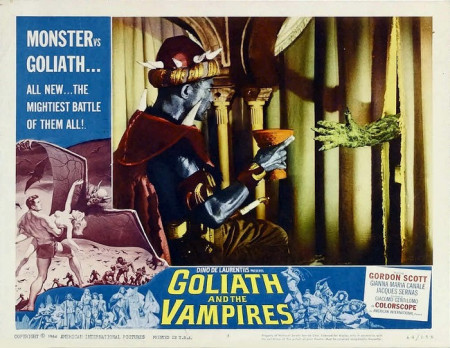
This impurity was perhaps the defining feature of Italian products. It could be glimpsed in the haunting vision of Queen Lydia’s crypt in which former lovers become petrified statues in Hercules Unchained or the gruesome fate of the sacrificial victims to Proteus in Vittorio Cottafavi’s Hercules Conquers Atlantis (Ercole alla conquista di Atlantide, 1961). In Giacomo Gentilomo and Sergio Corbucci’s Goliath and the Vampires (Maciste contra il vampiro, 1961), the Oriental Kingdom of Salmanac is terrorised by a shape-shifting, blood-sucking apparition that materialises in wrathes of red mist, floating in mid air, fangs and talons poised to feast on the blood of virgins. Kobrak (‘the vampire’) is capable of changing his form at will: during the film’s climax he morphs into Goliath himself so that at the final moment, courtesy of some crafty special effects, Goliath appears to grapple with Goliath. The film is suffused with an atmosphere of spooky sadism and exotic sensuality, decorated with a bone-strewn desert, a depraved Oriental court and a frozen underground lair that conceals an army of blue humanoids. Goliath and the Vampires is a period adventure that exceeds every other production of the time by gleefully raiding adjacent genres (horror, science fiction). Corbucci, like Bava, had the talent and temperament as a director to take these things to their logical conclusion: his Roman epic Son of Spartacus (Il figlio di Spartacus, 1962) and Spaghetti Westerns Django and The Great Silence stand out for their handsome scale and pitiless brutality. 

This wildness, this lack of decorum and taste, a refusal to acknowledge any aesthetic boundaries and push at both moral and legal limits, became a basic driving force of Italian genre cinema, taken to extreme horizons by directors like Lucio Fulci and Ruggero Deodato. It pushed the peplum cycle through to its farcical end and ushered in the amorality, violence and eroticism of the Spaghetti Westerns, horror movies and gialli of the later 1960s. The brutality of the pepla set a precedent for the aesthetics of Italian film by depicting violence with more felicity and imagination than their American models. Movies like Goliath and the Vampires or Carlo Compagalliano’s ruthless romp Goliath and the Barbarians (Il terrore dei barbari, 1959) and his voluptuous, savage Son of Samson (Maciste nella valle dei re, 1960) opened with whole villages and towns being massacred in surprising, gory detail: the innocent burnt or  buried alive, stabbed or impaled, with no mercy for women or children. In later pepla like Son of Spartacus or Ferdinando Baldi’s Son of Cleopatra (Il figlio di Cleopatra, 1964) the brutal, parched landscape, visual motifs and pessimism of the Spaghetti Western had started to be sketched out — pitiless bursts of violence perpetrated by desperate men on horseback in barren desert wastelands. 

The violence was balanced by an extravagant sensuality that was deliberately provocative — the basic currency of Italian cinema. There is a retrospective tendency to focus on the homoerotic presentation of the lead actors in the pepla: bodybuilders like Steve Reeves and Reg Parks romping around in skimpy loincloths, flexing oily torsos and wrestling circus lions. But this is misleading, ahistorical and misses a key point: the pepla often revolve around the motivations, machinations and sexual allure of their women. The female characters were not just sex objects in these films: their erotic charisma often suffused the entire narrative and propelled it. If the central protagonist was invariably the muscular and moral hero, a Hercules or a Maciste, then his real nemesis was more often than not a dynamic and seductive queen or courtesan, forerunners of the Gothic femme fatales looming on the horizon. Occasionally controlled by a larger, more malevolent force (Kobrak in Goliath and the Vampires; a race of rock-headed, be-caped aliens in Giacomo Gentilomo’s legitimately camp and demented Hercules Against the Moon Men), they invariably stole the show. 

Hercules Unchained, for example, belonged to Sylvia Lopez, the tragic starlet who died of leukemia one year after the film was released. Her Queen Omphale is an outstandingly lurid and febrile creation: decked in gossamer suits and diaphanous gowns with eyes like steel daggers and lips like lava, she is eventually driven mad by desire, immolating herself in her own cave of horrors like a Technicolor Barbara Steele. In Son of Samson and Goliath and the Barbarians, Chelo Alonso (“the Cuban H-Bomb”) provided a lethal sexual charge by deploying seductive dance routines learnt at the Folies Bergere in Paris, vamping and murdering her way through the Mongols of Central Asia and the dangerous schemers of Pharaonic Egypt in luxurious and only vaguely period-appropriate couture mini dresses. As Queen of the Amazons in Hercules, a wily courtesan in Goliath and the Vampires or a corrupt and lusty aristocrat in Son of Spartacus, Gianna Maria Canale exuded a graceful and intelligent menace that finely balanced the outré sexuality of Alonso and Lopez. Lydia Alfonsi excelled at the role of Prophetess often key to the mythological mini-epics, adding mystery and dignity to such roles as the Sybil in Hercules and Cassandra in Giorgio Ferroni’s The Trojan Horse (La guerra di troia, 1961). In their original context these films pushed boundaries to produce some of the most memorable yet forgotten lead performances by any Italian actresses.  

The peplum provided a perfect vehicle for the visual sensibility of the Italians, and an important opportunity to develop their talent and expertise in special effects, set and costume design. If there is one thing that distinguished the best Italian productions from their American models, it is their rich visual texture. The Italians presented their stories in dynamic, saturated colour. Caves, grottoes and crypts were drenched in jarring blues and livid reds, piercing golden shafts and aquamarine washes. Pioneered and inspired by Bava, the lighting did a lot of work: cheap tricks devised to conjure vivid and unnatural dream states and hallucinatory nightmares. In fact, the visual signature of Mario Bava is all over the most effective and beautiful-looking pepla, even those without his direct involvement like Hercules Conquers Atlantis (a visual and thematic wonder), or Goliath and the Dragon (Le vendetta di Ercole, 1960) in which Cotaffavi painted a broiling volcanic landscape that was only let down by the ridiculous fire-breathing rubber puppet that Mark Forest wrestled at the climax of the film. Most productions required a dance sequence, both an obligation and a chance to show off: in the hands of Bava these became extreme candy-coloured confections, inserts of exotica that enhanced the dreamy delirium, like budget versions of the Powell and Pressburger ballet extravaganzas in The Red Shoes and Tales of Hoffman.

In the gutter of the Italian film industry — where outrageous talent and motivated hacks combined to create magic in a world that was both mercenary and anarchic — the pepla provided the likes of Bava, Freda, Leone and Corbucci with the opportunity to begin to realise their own style. They were able to curate and train their own audiences here, feeding them lavish fantasy and extravagant spectacle in regional cinema pits. This was the first filone and it set the commercial and stylistic template for the Spaghetti Westerns, spy capers, Gothic horrors, gialli and poliziotteschi to come. The tendency towards extreme mannerism established during the peplum era would be fully developed in everything that followed — the thread that started here can be traced all the way through to the visual assaults of Dario Argento and Lucio Fulci. With their grand themes and frantic approach, these films wore the scars of Italian society in the heat of industrial and cultural revolution, but, like the Gothic horrors and Spaghetti Westerns, they did not try to preach or convert. Like the best Hollywood genre products, the ideas they explored were not delivered as programmes or slogans, but symptoms of fear and desire, aspiration and dislocation (2). Ignored now, they are worth revisiting (and where possible, fully remastering, 3) for their visual and stylistic achievements but also as central and living documents of a country with unmatched cultural resources and abilities being transformed at every level, from every direction. They are waiting, still, to be rescued and rediscovered. 

  1. ‘Centaur’s Food’ in Robert Graves, Food for Centaurs (Doubleday & Co., 1960). William Graves would partly blame use of psychedelics for his father’s late mental decline, see Joshua Hammer, ‘Robert Graves Found ‘Perfect Tranquility’ in Majorca’, New York Times, July 3, 2015
  2. The best example of this is perhaps Hercules Conquers Atlantis, in some ways the most ridiculous of all the pepla but also the most interesting. In the film, Queen Antinea’s Atlantis is a technocratic tyranny with eugenic ambitions to “change men…create a new race.” The mythological setting tilts into science fiction and even exploitation, with its Futurist cityscapes and charged erotic apparel: the fetishistic black leather uniforms and weapons of Queen Antinea’s guards, as well as her own prowling, vicious performance as a kind of Atlantean dominatrix. The thematic echoes of Mussolini’s own mad dreams of a fully aestheticised and pure totalitarian state are obvious and it is worth remembering that these films were being produced only fifteen years after the final destruction of fascism in Italy.
  3. The model would be Arrow Films’ exquisite release of Erik the Conqueror: their 2K  restoration (with the original Italian vocal track) is a revelation. The reputation of films like Hercules, Hercules Unchained, Hercules in the Haunted World, Hercules Conquers Atlantis and Goliath and the Vampires would be transformed by similar treatment and presentation. Whether this will ever be possible, either technically or commercially, is another matter. 
Posted in Uncategorized | Leave a comment

The Jews in Fascist Italy

A 36244

And he would shake his head, with the expression of someone who, should they wish to, could even understand such subtleties and complications, but who is just not minded to. Such tiny fine discriminations, intriguing and engaging as they might be, at a certain point became irrelevant: they too would be swept away.
Giorgio Bassani, The Garden of the Finzi-Continis (1)

Looking back after the destruction of Europe’s Jewish communities by the Nazis, the experience of Italy’s Jews both before and during the Second World War is full of tragic contradictions and historical ironies. In his 1962 novel The Garden of the Finzi-Continis, Giorgio Bassani portrays some of these complexities as experienced by the Jewish community of Ferrara, seen retrospectively through the eyes of Giorgio, the semi-biographical narrator who recounts his youthful infatuation with Micol Finzi-Contini and her reclusive, wealthy family. 

Two months after the introduction of the 1938 Racial Laws, Giorgio has a heated exchange with his father that captures the defiance and denial that was still being expressed at this late stage by many Italians, including Italian Jews:

“I hope you won’t want to start on the usual story,” I interrupted him, shaking my head.

“What story?”

“That Mussolini is more good than Hitler.”

“I know, I know,” he said. “But you have to admit it’s true. Hitler’s a bloodthirsty maniac, whereas Mussolini is what he is, as much of a Machiavellian and turncoat as you want, but…” (2)

Even at this point there was reason for uncertainty and indecision, if not complacency. Until the Racial Laws, modern Italy had no real tradition of antisemitism to compare to other European nations. The introduction of racist legislation triggered shock and open revulsion throughout the country and caused a “crisis of conscience” in the Fascist movement itself (3). The cynics and antisemites of the party elite — men like Roberto Farinacci and Giovanni Preziosi — understood the need to “prepare” Italians for this new policy, which many considered “the ‘barbaric’ and ‘Celtic’ doctrines from beyond the Alps” (4). The Laws were preceded by a change in the tone and reporting of Jewish stories in the national press, followed by the publication of ‘The Manifesto of the Racial Scientists’ which was generally met with disgust and derision (according to Giorgio’s Communist friend Malnate, “it was hard to know whether it was more shameful or more ridiculous,” 5). Renzo De Felice described the Manifesto — the first clear shot in the antisemitic campaign in Italy — as “a text that, from every point of view, scientific, political and moral, remains one of the worst and shabbiest episodes of the Fascist period” (6). However, these measures singularly failed in their aim to convert Italian public opinion to antisemitism for the simple reason that most Italians could see no reason to discriminate against those citizens they had worked with, lived with and married without prejudice since the Emancipation.

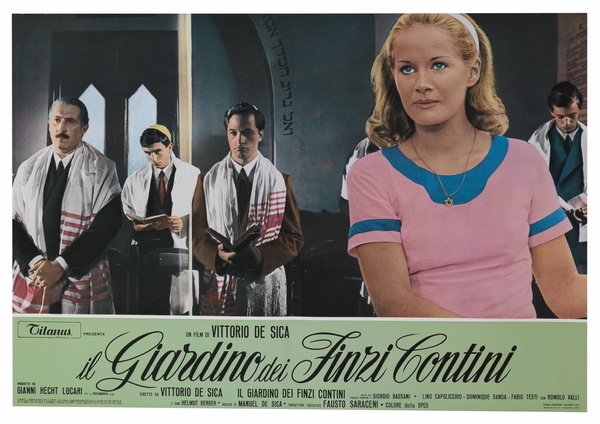
The Jewish population of Italy is highly assimilated, successful, and ancient. The first Roman Jews settled in the Second Century B.C. and the Jewish community of  the Portico d’Ottavia neighborhood — the ghetto liquidated by the Nazis in October 1943 — dated back to Emperor Vespasian. The word ‘Ghetto’ partly derives from the original segregation of the Venetian Jews in 1516 on the site of a foundry (‘getto’). The Emancipation and the Revolution of 1848, the Risorgimento and the liberal regime that followed unification, successively secured their status. They prospered and integrated. Many distinguished themselves in the Great War and subsequently participated in the early squadristi and local Fascist parties. In The Garden of the Finzi-Continis, Giorgio’s pen portrait of his father is intended to symbolise an Italian (not only Ferrarese) type from the subsequent period: “medical graduate and free-thinker, army volunteer, since 1919 card-holder of the Fascist Party, and sports enthusiast, in short the Modern Jew” (7). In the novel, his father never fully recants his allegiance to the Fascists; in Vittorio de Sica’s 1970 film The Garden of the Finzi Contini, however, this aspect is muted and his final rejection of the regime is shown in the closing scenes. This was a serious point of contention between the novelist and film-maker, erasing the record of local participation in Fascism by the Ferrarese Jews, effectively covering it with a general (if moving) portrait of persecution. But the power of Bassani’s novel is precisely this exploration and exposure of the accommodations made with the regime and its subtle entwinement in everyday life and communal self-awareness even at a moment of grave and growing danger.  

The reasons that Jews could accommodate and participate in Fascism before and even after the introduction of the Racial Laws were numerous and as contingent as the regime itself. As Michael Ledeen wrote in his book on the short-lived Fascist International, Universal Fascism:

Like all other Italians, the Jews saw a variety of tendencies at work in the Fascist Regime. What they saw most clearly, however, was that the situation of the Jews got better and better over the first decade of fascist rule. They consequently behaved pragmatically when they supported a government which not only improved their legal status but […] also became for a time one of the foremost advocates of the Zionist cause in Europe. (8)

Giorgio’s father accuses the Finzi-Contini of avoiding the local community by joining the “scornful isolation of the Spanish synagogue” without even being “good Zionists” to warrant it:

Given that here in Italy, and in Ferrara, they always found themselves so ill at ease, so out of place, they could at least have benefited from this situation and taken themselves off, once and for all, to Eretz! But not at all. Apart from fumbling every now and then for a wee bit of cash to send to Eretz (which was nothing to boast of, anyway) the thought of going had never even crossed their minds. (9)

Mussolini’s shifting attitude towards Zionism illustrated those particular traits recognised by Giorgio’s father at a different moment: cynical, “Machiavellian” and “turncoat”. In the attempt to consolidate Italian influence over the Mediterranean, Zionism had proved to be a useful if temporary tool. Mussolini conducted cordial meetings with Chaim Weizmann and Nachum Sokolov and from 1932 his regime collaborated with Ze’ev Jabotinsky and the Revisionist Zionist movement. By 1937, different considerations and tendencies abruptly ended this accord, as Renzo De Felice detailed in The Jews in Fascist Italy:

The Zionist card had lost its value in the eyes of the Fascists: alliance with Germany, a pro-Arab policy, and a Mediterranean agreement with England had modified the view the Palazzo Chigi had of Palestine. The efforts of those Jews who, feeling the storm rising above their heads, tried to ward it off by attempting to convince important Fascist leaders that Italy could at last replace Great Britain within the mandate over Palestine, came to nothing. (10)

The Jewish community of Ferrara was one of the most successfully assimilated in Italy and this is why the the fate of the city’s bourgeois milieu so effectively illustrated the overall tragedy of the Italian Jews, in both Bassani’s fiction and the historical archives. Alexander Stille described how, in Ferrara,

an ancient bond of tolerance and affection tied the Jews to their city. From as early as the thirteenth century, it had distinguished itself among Italian city-states for its religious openness…while most other cities prevented Jews from doing any business other than banking, to avoid competition with local merchants, Ferrara granted them full rights. (11)

This was interrupted by the city’s absorption into the Papal States in 1597 which saw the creation of the ghetto and the abolition of civil rights for Jews. Following liberation, the story of the Jewish community was one of energetic integration and significant contributions to the development of the Italian state. During the Fascist era many middle class Ferrarese Jews were members of the Fascist Party (like Giorgio’s father) and Bassani himself claimed that when he was growing up he did not recall a single Jew in Ferrara who was not a Fascist. The Garden of the Finzi-Continis portrays the moment this concord fell apart.  For Giorgio’s father the full import of the Racial Laws does not immediately register and is deflected by rage and suspicion at the aloof attitude of the Finzi-Continis: “Of course […] they were pleased with what was happening! Because to them, halti as they’d always been (anti-Fascist, sure, but above all halti) deep down the Racial Laws gratified them!”(12)

In his group portrait of five Italian Jewish families during Fascist era, Stille documents the fate of the Ferrarese Schönheits who were sent to Fossili before their final deportation to Buchenwald, like the fictional Finzi-Contini. He quotes Franco Schönheit who recalled the reaction of the Ferrarese Jews to the Nazi assault on the Roman Jews in an interview with the author:

We heard about the October roundup in Rome the day after. Trains carrying prisoners from Rome had passed through Northern cities, and the people inside had thrown postcards and letters from the cars. But we were very incredulous. Italian Jews in general were very incredulous. German refugees who had escaped into Italy would take every opportunity to warn Italian Jews about what was happening to Jews in Germany, but we always said, ‘What happened in Germany can never happen in Italy.’ You heard that phrase constantly, up until the end. (13)

It became difficult, if not actually impossible, for Italian Jews to remain loyal to the Fascist Regime after the promulgation of the Racial Laws. This was also true for Italians in general and marked the beginning of Fascism’s decline in Italy. Renzo De Felice writes:

Those who had shunned politics up to that moment and had, so to speak, “delegated” it to Fascism, began, during the second half of 1938, to think for themselves once again […t]he corruption, the immorality of Fascism, quickly became obvious to everyone, causing disgust, solidarity with the Jews, and loss of confidence in the state. (14)

For the majority of Jews who felt loyal to Italy and who believed that they owed their emancipation and equality to the birth of Italian State, the conflict was profound:

The realization that Fascism did not represent Italy, and had not made a mistake or misunderstood them, was slow and painful. Fascism had consciously and cynically prepared and undertaken their persecution and it was now useless, naive, and shameful to attempt to convince it of their “good faith” through demonstrations of loyalty, which it obviously did not deserve and in which Jews no longer believed. (15)

But there were even some Jewish exceptions to this. Stille recounts the tragic story of Ernesto Ovazza, a leader of the Fascist ‘bandieristi’ group and the Jewish Community in Turin who felt certain that his well-documented loyalty to Mussolini would save his family from persecution. He held onto this conviction until they were literally dragged out of their hotel in the Italian Alps to be executed and incinerated by drunk SS guards. Before leaving Milan himself, Ovazza told fleeing relatives, “they’ll never touch me, I’ve done too much for Fascism.” Stille quotes another fugitive who encountered Ovazzo at a later date, in hiding: “During several walks we took together he always seemed rather calm because he claimed to have in his possession a signed photograph of Mussolini dedicated to him” (16).

The arc of Ovazza’s story provides some insight into the way that Jews were able to find a place within Fascist Italy that was not possible in Hitler’s Germany. Fascist elitism diverged from Nazi racial genealogy in its conception of the New Man as well as its “spiritual” racism.  The Italian Fascist ideologues — and Mussolini early on — conceived of Fascism as a revolution of the spirit: dynamic and open-ended where Nazism was fixed and reactionary. As De Felice noted in his famous 1975 Intervisto sul fascismo,

[w]hile Nazism has a revolutionary appearance through its mobilization of the masses, insofar as the transformation of society is concerned it moves on a double path different from the Italian case. It seems to create a new society, but the most profound values on which this society must be created are traditional, antique, and unchangeable…Nazism sought a restoration of values and not the creation of new values. The idea of the creation of a new kind of man is not a Nazi idea. (17)

De Felice viewed Italian Fascism as a movement with roots in the French Revolution (18), an analysis that provoked hostility in post-war Italy where the Communist Party laid claim to the revolutionary tradition and the legacy of the Resistance was appropriated by the First Republic. But even the Fascist cult of violence had roots on the revolutionary Left (influenced by Georges Sorel and the Syndicalists) and there was a persistent tension in the movement between traditional nationalism and revolutionary avant-garde tendencies. George L. Mosse, in his essay ‘Fascism and the Avant Garde,’ wrote:

Italian Fascism was certainly more open to the future than German National Socialism; the new man of the south had avant-garde features lacking in the north, where the ideal German was the ancient Aryan whom Hitler had roused from centuries of slumber. Mussolini was much more ambivalent…[he] did leave the door ajar to the future, while in Germany nationalism and racism blocked all exits. Neither Mussolini nor many of his followers gave up the idea that fascism, while rooted in the past, was not destined to cling stubbornly to these roots. Nevertheless, however uncharted the new spaces, they were to be controlled and dominated by a national stereotype, rooted as a matter of fact in the imagery and the ideals of the attempted revolution of bourgeois youth at the fin de siecle. (19)

Even after the adoption of antisemitism and racist policies it remained important for the Italians to distinguish themselves from the Nazis. Due to the very composition and history of Italy, their racial ideal could not be the pure Aryan of the Northern imaginary and could not completely break from the mystical and Idealist ideas espoused by Arnaldo Mussolini, Giuseppe Bottai and Giovanni Gentile. On a practical level, Mussolini had been drawn towards racism during the military campaigns in Libya and Ethiopia, when he decided to emphasise the superiority of Italians over Africans for the purpose of war propaganda and to condemn reports of the sexual activities of Italian troops. Antisemitism was a harder sell and Mussolini’s own rhetoric even more wild and contradictory than on other topics: he could often be candid about the tactical cynicism of antisemitism, stating as late as 1938 that Italy had no ‘Jewish Problem’ and describing Mein Kampf as “that incoherent tirade I have never managed to read” (20).

Once racism and antisemitism had been incorporated into the Fascist programme attempts began to theorise this turn in line with the doctrines of “revolutionary fascism”. Again, this led to a key distinction with Nazi racial doctrine and its pseudo-biological Weltanschauung, fixed and immutable, with non-Aryans marked for slavery or extermination. For Mussolini and the Fascists the difference between Italians and Jews became a spiritual contrast, as described by Ledeen:

For Mussolini there were various spiritual types in the world, and he believed that at certain dramatic moments in history it was possible to speak of “races” becoming coextensive with “nations.” Such was the case with fascist Italy, where the genius of the Italian race (a spiritual “type”) had made it possible to begin the construction of the Fascist State. Yet within that State were some recalcitrant elements, which did not share in the qualities of the “race,” which did not adapt to the new spiritual climate of the period, and which insisted on clinging to the values and goals of an earlier, corrupt epoch. The purpose of the antisemitic policies, as viewed by the Duce, was to retrain these elements, to Italianize and “fascisticize” them, and finally to reintegrate them back into fascist society. When this reintegration was achieved, the Italian “race” and the Fascist State would be coextensive, both geographically and spiritually. (21)

That is: “The Fascists insisted upon their ability to change the human spirit”. Even their most discriminatory policies, in theory if not practice, left enough ambiguity for those inclined to find some psychological space in the Fascist state. After the Racial Laws, Ettore Ovazza did not protest against the Fascist policy, but severed all connections with organized Judaism, “protesting what he believed as the Jewish community’s insufficient fascist rigor” (22). This chaos of tensions, ambiguities and contradictions within Fascist doctrine is key to the attitudes and fate of Italian Jews during the Fascist epoch but also the final destruction of the Fascist state. It was crushed by a more ruthless and murderously deterministic regime than itself.

The clues to this outcome were evident in the early 1930s. In 1934, the Italians organised a pan-fascist congress at Montreux under the leadership of the Comitati d’azione per l’Universalità di Roma (CAUR). Representatives of fascist movements arrived from across Europe, apart from the Nazis who refused to attend. The trigger that undid this enterprise was the Jewish Question, tabled by the pro-Hitler Romanian Iron Guard contingent. The conference split along national lines and in common with their hostility or sympathy to the Nazis. At this point Italy retained a position of prestige within the prospective Fascist International and was far from adopting its own antisemitic policies. In fact, at this stage, antisemitism served to highlight the division between the Italians and Germans. The resolution of this split sealed the fate of Italy’s Jews.

Nazism was a terminal ideology for European Jews which could count on traditions of antisemitism in countries like Poland, Ukraine and Hungary to facilitate its genocidal goals. Italy and its Fascist movement was a more complex proposition. It had antisemites and racists among its elite hierarchy and followers, but these ideas were marginal until 1937. Ultimately it was Italian Fascism’s protean and opportunistic nature, aligned with the cynicism of its leadership, that proved deadly for the Italian Jews, rather than any large-scale antisemitic currents within Italian society. This endpoint was as inevitable, maybe, as the Italian Fascist regime’s squalid and violent collapse; the seeds for catastrophe sown at the start.

  1. Giorgio Bassani, The Garden of the Finzi-Continis (Penguin, 2007, trans. Jamie McKendrick), p. 223
  2. Bassani, p. 58
  3. Michael Ledeen, Universal Fascism – The Theory and Practice of the Fascist International, 1928-1936 (Howard Fertig, 1972),  p.134
  4. Ledeen, p.132
  5. Bassani, p.136
  6. Renzo De Felice, The Jews in Fascist Italy: A History (Enigma, 2004, trans. Robert Miller), p.265
  7. Bassani, p.34
  8. Ledeen, p.137
  9. Bassani, p.61
  10. De Felice, p.173
  11. Alexander Stille, Benevolence and Betrayal – Five Italian Jewish Families Under Fascism (Vintage, 1993), p.284
  12. Bassani, p.61
  13. Stille, p.283
  14. De Felice, p.297
  15. Ibid., p.317
  16. Stille, p.86
  17. Renzo De Felice, Fascism: An Informal Introduction to its Theory and Practice (Transaction, 1977), p.56
  18. This analysis is influenced by J. L. Talmon’s The Origins of Totalitarian Democracy. See De Felice, Fascism, p.106: “Insofar as Italian fascism is concerned, I am in complete agreement with Talmon’s analysis; but I do not agree if it were extended to nazism. I, too, see in fascism a manifestation of that left-wing totalitarianism of which Talmon speaks. Nazism, however, is tied to a right-wing totalitarianism and should be discussed in terms of a different analysis…”
  19. George L. Mosse, The Fascist Revolution: Toward a General Theory of Fascism (Howard Fertig, 1999), p.150
  20. Denis Mack Smith, Mussolini (Paladin, 1983), p.256-7; Ledeen, p.101
  21. Ledeen, p.150
  22. Stille, p.78
Posted in Uncategorized | Leave a comment

The Haunting of Yulia

A spectre is haunting Ukraine – the spectre of Yulia Tymoshenko.

Her presence has been largely erased from the anti-government protests that have convulsed Kiev since the 21st November, the day President Viktor Yanukovych formally abandoned Ukraine’s Association Agreement with the European Union. Tymoshenko is not simply invisible, but conspicuous by her absence. Fatherland party loyalists are among opposition leaders and protesters and a few pro-Tymoshenko portraits and banners can be seen on the Maidan, but that is all. Her short-lived hunger strike did not inspire waves of solidarity or even much interest, to her chagrin. Most galling for her – and ironic, and interesting – is the news that former Orange Comrade Victor Yushchenko has shared a conspicuous platform with her arch-foe Leonid Kuchma in support of the protests (Kuchma once described the choice between Yanukovych and Tymoshenko as “bad and very bad”). Tymoshenko — Orange Icon, Gas Princess — is being sidelined by her constituency and her enemies. Shut away in a prison hospital, prize captive of Yanukovych, she has been cut out of the action — her words a pale echo of former stridencies, relayed by loyal daughter Eugenia and almost lost on the freezing Kiev air.

But she is there – and more potent, in some ways, because of her absence. Why? Well, for one thing, the EU controversy is partly about her. Yanukovych surrendered European ambitions to Putin for two complimentary reasons: direct Russian threats and calls by EU leaders to release Tymoshenko from prison. Despite his status as Russia’s man in Ukraine, Yanukovych has struck a complicated balance between total capitulation to Russian demands and serious flirtation with EU overtures. To be as pro-Russian as Putin demands would be to surrender key elements of sovereignty – over Crimea, over energy policy, over language rights. However, releasing Tymoshenko to satisfy Europe is completely out of the question. As far as he can, Yanukovych runs Ukraine as a family fiefdom (protestors and opponents call his party circle ‘The Family’) and this particular incarceration is not only political, it is also personal. In partial response to this EU demand he has re-orientated Ukraine into the Russian sphere, an alternative orbit defined by the Eastern Partnership and the Customs Union. This puts Ukraine on a political par with Belarus rather than, say, recent Vilnius Summit hosts Lithuania (where, of course, part of this drama played out). As ever, Andrew Wilson is the best English-language commentator on such events.

There is not exactly a base of mass support for Tymoshenko among the current Kiev protestors. She is considered another embezzling oligarch who subordinated the national interest to personal plunder while in power. She comes from the murky world of the Donetsk industrial and energy barons that she now attacks with such ferocity and is viewed with scepticism and suspicion for this reason. Like Victor Yushechnko, her popular support was damaged by the unedifying collapse of the Orange Coalition. She was wholly implicated in that catastrophe – from the personal antagonism and rivalries that poisoned her alliance with Yushchenko to her fatally mismanaged negotiations with Putin that finally fractured the pro-European front. This joint failure led to mass disillusionment and apathy in the civil society of West Ukraine and the restoration of Yanukovych and the Party of Regions cartel.

Actually, as I have argued before, Tymoshenko’s dubious reputation and failure in office is less important than it seems. She was essentially transformed by her violent feud with Kuchma and the grand drama of 2004; she became a transitional and transcendent figurehead despite her past record and ruthless methods. By fashioning a powerful aesthetic image for herself, she physically embodied a pro-European Ukrainian nationalism that rejected the Soviet past and authoritarian Putinism. Ejected from office, tarnished and scarred, she was the only original Orange partner to maintain fierce and vocal resistance to the Party of Regions power-brokers on an international stage. Her furious Rada interventions throughout 2010 – notably when Yanukovych extended the lease on the Black Sea Fleet’s Crimean base – were unhinged blasts of invective designed to expose the dangerous sell-out of Ukraine to Russian interests. (Meanwhile Yushchenko – the man Putin and Yanukovych were willing to disfigure and probably kill in 2004 – was compliant and compromised, more interested in undermining former allies than the new regime.) There was no option but to jail her – and for as long as possible. For the opposition, with all its disappointments and alterations since 2005, she remained a significant liability. But who else fought their corner with such intensity?

The most charismatic and effective leaders of the Colour Revolutions that rocked Putin’s world in 2003-5 have since been brought low, their administrations sunk and reputations shredded. Nevertheless, they have formed bonds in a pro-European front against the territorial ambitions of Putin and the venality of his external allies and stooges. This was dramatized by the miraculous appearance of Mikheil Saakashvili on Independence Square on Saturday 7th. Flanked by former Moldovan Prime Minister Vlad Filat, a key-link in the anti-Putin chain, Saakashvili used language provocatively redolent of the days of Orange and Rose. “I am Ukrainian, I am Georgian, I am European,” he blustered, “I knew that one day Ukraine would become an example of success, an example of an Eastern European nation integrated into the European family of free, democratic, prospering countries. Today I see that I was right. Ukraine will be able to do this – we will do this together.”

This sounded impressive, but the former Georgian president has just been ejected from office by an administration slightly more amenable to Putin – another victim of the Russian Restoration (or “political has-been” as Kremlin TV station RT kindly put it). Nevertheless, this intervention made the key point: what happens in Kiev still reverberates in Tbilisi, Minsk, Chişinău, Tashkent, Baku, Bishkek and Moscow itself. As Wilson notes, the Russian opposition defeated in the streets during 2011-12 have been transfixed by the Ukraine protests. Belarusians travelling to Kiev in solidarity were denied entry at border crossings, with traffic officers puncturing their tires for good measure. Euromaidan, like the Orange Revolution before it, is a regional – an international – event.

But the risks are huge and the prognosis bleak. In 2003-5, from Freedom Square in Tbilisi to the massacre at Andijon, the revolts became more violent and chaotic as a result of their success – a logic followed by the Arab Spring. After 2005, dictators and their terror proxies took control of the situation as the West capitulated and receded. Since then, revolution and chaos has spread across the Middle East and South America. Western capitalism has been damaged – functionally and symbolically. The global and theoretical status of democracy itself has been diminished. The U.S. has retreated from the Middle East and Eastern Europe. In this context, in 2013, the pro-Western Ukrainians are left with no champion but a chastened and retracting EU, while Washington remains largely silent. The politicians who led the Orange Revolution in 2004 have failed and been thrown out of office, leaving a motley crew of chancers and sinister ultra-nationalists to capitalize on anti-Yanukovych unrest – and these people are not necessarily pro-European because they are anti-Russian, even if they are anti-Russian.

Euromaidan is leaderless – its objectives improvised and potentially unlimited, both a strength and a weakness. In domestic terms, its enemies are the Party of Regions and Yanukovych’s governing gang, the Communist Party and the Russian Bloc, and a silent majority in the Russian-speaking Eastern oblasts. This uprising, in cities across Ukraine and not only Kiev, is the result of failure, corruption and misrule – of a country handed back to the worst gangsters they have, the very people deposed in 2004 for their criminality. A new administration is needed to bring Ukraine back to Europe, to both follow and strengthen Georgia and Moldova – an administration that echoes the original Orange compact, with the West out-balancing the recidivist East and the democrats keeping grass-roots pressure on authoritarians and nationalists alike. Ukraine has unique ties with Russia that can’t be dissolved or ignored – complex trade agreements and energy considerations that EU officials failed to understand or fully consider in their botched negotiations. Russia outplayed Europe in this round, but Ukraine has a different fate and a different future articulated by the Euromaidan Ukrainians who do not who want their country to remain captive to oligarchs, energy mafias, security thugs and antisemitic fascists.

Posted in Uncategorized | Leave a comment

Ezra Pound & Salò

ezra-pound-2

I want to go on fighting.
Canto 72

In 1948, the year James Laughlin published The Pisan Cantos, Ezra Pound remained incarcerated in St. Elizabeth’s Hospital, a Federal Government asylum in Washington, having been found mentally unfit to stand trial for treason. During the war, Pound was a vocal antisemite whose sympathies lay with the more extreme sections of the Italian Fascist regime in Salò and with the Nazis, as he openly declared in pro-Axis propaganda broadcasts on Rome Radio. This endpoint was evident, and expressed, in his poetry, including The Pisan Cantos which won the Bollingen Prize in 1949, awarded by the Fellows in American Letters of the Library of Congress, among them T. S. Eliot, Robert Lowell and W. H. Auden. These highly accomplished men were perceptive and conceited enough to pen a pre-emptive defence of their controversial choice, made only four years after the discovery of Auschwitz and Buchenwald. It stated: “To permit other considerations than that of poetic achievement to sway the decision would destroy the significance of the award and would in principle deny the validity of that objective perception of value on which any civilized society must rest.” Or, in other words, l’art pour l’art.

Partisan Review, among other organs, invited comment. Karl Shapiro, a Fellow, disagreed with the selection on the grounds that “the poet’s political and moral philosophy ultimately vitiates his poetry and lowers its standards as a literary work” (1); Dwight Macdonald, by contrast, viewed the award as a  supremely civilised act and a rare example of national magnanimity. George Orwell composed a more subtle position, making two points with direct relevance to contemporary Pound studies, that obtuse critical subgenre. Firstly, he objected to the artificial separation of Pound’s political activities from his poetry, a division never made by Pound himself who considered his adopted economic theories (for one thing) to be central to The Cantos’ purpose, aesthetics and meaning. The tendency to ignore or rationalise the poetry’s politics — the thematic content of The Cantos, in other words — grew among and with Pound’s influential friends, acolytes and protégées after the war, notably Louis Zukofsky, Charles Olson, Hugh Kenner and James Laughlin. These entwined artistic and critical circles preferred to emphasise Pound’s aesthetics at the expense of his economic and racial politics, as if The Cantos could exist without Social Credit, history and Jews, and live through their lyrical technique alone.

Pound learned to accept this in his very late years — in the Sixties, when it was most convenient to do so. By this time he could tell Allen Ginsberg that antisemitism had been his “worst mistake” and write to Robert Lowell: “that nonsense about the Jews…Olga knew it was shit, yet she still loved me.” (2) This was also the time, non-coincidentally, when he admitted that, by his owns standards and expectations, The Cantos had been a failure. He would tell Daniel Cory: “I botched it. I picked out this and that thing that interested me, and then jumbled them into a bag. But that’s not the way to make a work of art.” (3) Nevertheless, as late as 1959, Pound was sending poetry and Social Credit pamphlets to Oswald Mosely’s post-fascist European journal; and in the middle of the Fifties, Pound acolyte John Kasper achieved some notoriety as a segregation activist in the American South, spreading antisemitic and racist screeds encouraged by the unrepentant poet. His late disavowal of antisemitism made it more convenient for a Jewish Communist like Zukofsky and a Catholic conservative like Kenner to approach their idol with easier conscience and less prickly questions, but the racial instincts and devotion to Social Credit theories (with their distinct flavour of conspiracy theory) remained. Some put this down to mental health problems; others simply accepted Pound’s recantations and overlooked his unseemly actions and associates, dismissing these as anecdotal and historical. Orwell spotted all of this early and immediately skewered it: “He may be a good writer […] but the opinions he has tried to disseminate by means of his works are evil ones…” (4)

Secondly, Orwell noted a more brazen attempt to fully expunge Pound’s politics: “there has been,” he wrote, “a tendency to claim that Pound was “not really” a fascist and antisemite, that he opposed the war on pacifist grounds and that in any case his political activities only belonged to the war years.” (5) This was nonsense, of course. As Orwell had no difficulty illustrating in 1949, Pound’s own activities, pre-war and after, exposed this fallacy; more importantly, the poems vividly demonstrated Pound’s commitment to Social Credit ideas and to Italian Fascism. For Pound’s non-fascist supporters this made rationalisation more important and urgent. It could get desperate. For example, William Cookson, in his commentary A Guide to the Cantos of Ezra Pound, made an unintentionally acute attempt to redeem Pound’s wartime radio propaganda: “at their core the speeches are a document of anti-war literature. Incidentally, much that he said against “U.S. economic aggression” made good sense and has an affinity with the more recent polemic of Noam Chomsky”(6); he also described the subject of Canto 73 (see below) as being “like a suicide bomber.” Cookson was sharper than he realised, perhaps: there is the distinct shade of anti-capitalist and anti-American politics that unites far-left and right in the subject matter of The Cantos and Pound’s politics; an attachment to crank economics and conspiracy theory that leads, eventually and inexorably, from left or right, into the gutter of antisemitism. (If Pound had been writing today, would there be a Bilderberg canto?)

Cantos 72 and 73 are the low point of Pound’s own descent into Inferno in the tragi-comic form of Mussolini’s fall. The poems were both composed in 1943 in Italian, as the fascist dream collapsed in Italy with the Allied invasion and German occupation of the peninsula. Pound fled North, on foot and by train, sleeping in the open and eating with peasants, to link up with the remaining regime loyalists at Lake Garda. After returning to Rapallo he committed himself fully to the Axis cause, writing newspaper articles and manifestos in defence of the new republic. Salò appealed to him, as it did to other early Italian Fascists who had become disillusioned with the ‘Mussolinism’ of the Thirties; there was purity and potential in this new experiment, an uncompromised, activist esprit de corps that revived memories of the old movement. Mussolini was returning to socialism and syndicalism, while squadristi and regime protection rackets tortured and killed with impunity on the streets of Rome and Milan. The intellectuals and thugs were in charge, extremists like Roberto Farinacci and Alessandro Pavolini: a lethal combination. Pound wrote his two cantos for this regime to use against the Allies: they were propaganda pieces, advanced cases of fascist martyrology and idealism. Pound had apparently been further enthused by the violent, quasi-mystical defiance of Mussolini’s final public speech in Milan, 1944.

72 and 73 are evidence for the prosecution of Pound. In preceding poems he had prepared the ground for this full ideological and aesthetic embrace of the Axis cause. Canto 35, for example, presented a nasty satirical portrait of pre-war Viennese Jewish society. Canto 38 introduced Pound’s new and tragic obsessions: the arms trade and the Social Credit theory of Major C. H. Douglas. In Canto 41, the poet explicitly hailed il Duce (or “The Boss”). In Cantos 45, 46 and 51 the mortal enemy was identified: “usury,” the destroyer of civilisations. By 72 and 73 the contemporary forces of usury had been specified: “Geryon, prototype of Churchill’s backers”; “Roosevelt, Churchill, and Eden,/the Jews, the bastards,/swindlers, the whole lot liars…” All of this was in the air, of course, but the Jews were an obsession for Pound at a time when Mussolini’s regime still employed them, a situation altered by the 1938 racial laws. While not an overt Nazi sympathiser (though he shared their paganism and susceptibility to the occult) Pound’s antisemitism was more pronounced than many of the original Italian Fascists, and was there to be exploited when necessary, as Orwell recalled: “I remember at least one [broadcast] in which he approved of the massacre of the East European Jews and “warned” the American Jews that their turn was coming presently.” (7)

Pound’s full identification with the cause and methods of Italian Fascism is revealed in 72 and 73, exposing his doctrinaire extremism. Pound’s family and backers were aware of their damaging potential, and the Ezra Pound Estate has never been willing to authorise English translations of the poems; they were excised from the New Directions and Faber Cantos until the 1987 edition, when they were finally included as an appendix, in Italian and without notes. Even now, 72 and 73 are considered aberrations, rather than (as they are) exemplars of The Cantos’ dark energy and ideological propulsion. These poems are a logical outcome of the ideas and loyalties laid out in Pound’s epic; they are also a key moment in the poet’s own personal and aesthetic journey, a basic underlying pattern and narrative of his work. They express the despair and defiance of the loyalists of Salò: the men who stuck with Mussolini and imposed fascism in Northern Italy in pure, totalitarian form, without the compromise of private business, monarchy or the Vatican. These two cantos are Salò poems: the driving forces of the Italian Social Republic — defiance and loss, sacrifice and redemption — are played out, embodied in them.

So 72 and 73 not only reveal but explicitly confirm Pound’s intimacy with and loyalty to the actual actors and characters who theorised, built and ran the fascist state. Canto 72 exhumes the spirit of Marinetti, killed by cardiac arrest in 1944 but eager to return to the fight in Pound’s body: “I want to go on fighting/& I want your body to go on with the struggle.” Who, in this poem, is the fight against? “[T]he great usurer Geryon,” Dante’s symbol of Fraud and “prototype of Churchill’s backers.” Pound is the poem’s centre, its vessel, visited by four spirits (or “voices”): Marinetti; the librarian and translator Manilio Dazzi; the Venetian tyrant Ezalino da Romano; and (briefly) the Empress Galla Placidia. The tone is elegiac, as well as defiant: Pound is an interlocutor, weary and at one remove, but these voices also appear to transmit his owns instincts and obsessions. Romano lauds Farinacci — the former Fascist ras and party secretary described by Denis Mack Smith as “vindictive, ambitious…a dedicated believer in political violence” (8) — in terms that match Pound’s own obsessions: as one who has “seen thru the swindle” of the “followers of fattened usury.” He is “honoured by the heroes,” among them the fallen Italian Fascist generals intoned by Romano and listed by Pound, but singled out with approval because of his fanaticism and antisemitism. It doesn’t seem to me that Pound is distancing this selection by making it Romano’s; rather Farinacci is elevated, in this poem of loyalty, violence and despair, to a fascist hero, a figure close to Pound’s own ideal: man of action and enemy of usury. The poet is not simply channelling his apparitions, but engaging in ventriloquism: Pound uses them to convey personal obsessions and ideals.

Canto 73 is more explicit. The poet is at the service of the regime. This time Pound invokes Guido Cavalcanti, the medieval Florentine scribe and associate of Dante, to recall a contemporary story of an Italian peasant girl who, raped by Canadian troops, takes revenge by leading them into a minefield. The tone is rapturous: an ecstatic martyrdom in the genre of fascist and Nazi iconography: kitsch, quasi-mystical. She is pictured singing with joy, “so brave a spirit”, holding two Germans by the arm, “singing of love.” This is camaraderie within the Pact of Steel, but the girl has “no desire for heaven”: she becomes “defiant of death” only after her violation by Allied soldiers, that “filthy pack.” These are the shock troops of “Roosevelt, Churchill, and Eden,” the pawns of Jewish bankers and arms dealers, rampaging through Italy, desecrating ancient temples and raping small girls. Her death is an instance of the fascist ideal, and her spirit the expression of its soul: “the child’s spirit/courageously/sang/sang…Glory of the fatherland!/Glorious, it is glorious/to die for one’s country/in Romangna.” This is propaganda, and Pound sells his lyric gift to do it: the poem is ugly, crude, tedious. It remains interesting as fascist and Nazi art, tapping into neo-pagan, neo-Romantic volk iconography of German National Socialism and the neo-classical, militaristic kitsch of Italian Fascism. By the middle of the war years, the divisions, separations and tensions within and between the fascist states and movements had become less distinct or important, and Pound’s poems convey this pan-fascist aesthetic, an ideal clarified by Romanian Iron Guard leader Horia Sima: “We must cease to separate the spiritual from the political man. All history is a commentary upon the life of the spirit” (9). These words could summarise Pound’s ultimate intention for The Cantos.

Pound’s supporters creep from defence of the poetry to absolution of the poet; they appear to take his recantations at face value and over-estimate personal relations. (For example, Zukofsky: “I never felt the least trace of antisemitism in his presence. Nothing he ever said to me made me feel the embarrassment I always have for the ‘Goy’ in whom a residue of antagonism to ‘Jew’ remains.”) I think Orwell was correct to hold the poet to account for his rhetoric and his opinions; he was also right to dismiss the plea of insanity that Pound would adopt to save his own skin. Pound’s broadcasts, wrote Orwell, “did not give me the impression of being the work of a lunatic”; the poet was a clever propagandist who knew exactly how to play to an isolationist and anti-Allied audience. At Pound’s trial, the Superintendent of St Elizabeths hospital, Dr. Winfrid Overholser, was asked to present his confirmation of Pound’s insanity; however, he did not reveal to the court that his own doctors disagreed with his conclusions and considered Pound to be “merely eccentric and wanted to see him tried and convicted” (10). To accept that Pound was simply “insane” when he composed his polemics, be they Rome Radio scripts or Cantos 72 and 73, is to some extent to accept that all of The Cantos are deranged doodles, a repository of crank conspiracy theories and junk verse, psychological case studies rather than art. Orwell, for one, considered Pound’s work to be “spurious” as poetry, although not because the poet was mad; Robert Conquest did his own forensic demolition job on Pound’s classical pretensions in an attempt to undermine the poet’s carefully cultivated authority.

For modern poetry, or what is left of it (if anything), The Cantos remain, as Delmore Schwartz described them, a touchstone. Or as Basil Bunting wrote: “you will have to go a long way round/if you want to avoid them.” You don’t need to reject the poetry along with the politics, or make weak attempts to minimise or separate the politics to redeem the poems. It is a fragmented, incomplete, incoherent epic that veers between intense evil and luminous insight, and because of this retains a unique tension and a tautness despite the diffuse elements and ranging references. Fascism and antisemitism are unavoidable forces in The Cantos that must be faced and understood. In the end they do not reduce or invalidate the poem, but complicate and deepen its power.

1) Quoted in Noel Stock, The Life of Ezra Pound (Penguin,1974), p.546
2) Quoted in William Cookson, A Guide to the Cantos of Ezra Pound (Anvil Press, 2001), p.144
3) Quoted in Stock, p.586-7
4) George Orwell, ‘A Prize for Ezra Pound’, Essays (Everyman Library, 2002), p.1363
5) Orwell, p.1362
6) Cookson, p.115
7) Orwell, p.1362
8) Denis Mack Smith, Mussolini (Paladin,1983), p.81
9) Quoted in George L. Mosse, The Fascist Revolution — Toward a General Theory of Fascism (Howard Fertig, Inc., 1999), p.12
10) Stock, p.538

Posted in Uncategorized | 1 Comment

The Passion of Yulia Tymoshenko

Judges, in general, are fuckers.
Leonid Kuchma, President of Ukraine, 1994 – 2005

I: The Trial

The trial of Yulia Tymoshenko peaked with her arrest for contempt of court in early August. This had been a long time coming, although it was difficult to tell whether the judge, Tymoshenko or Ukrainian viewers gripped to their TV sets were satisfied or incensed by the course of proceedings. It had also become increasingly difficult to decide who was in control of events, or engineering them. Inside and outside the courtroom a grim media scrum ground out stock imagery of tent cities, government goons and broken eggs. At least part of this was inspirational, and part of it was sinister. But two separate sides were, once more, clearly visible.

Tymoshenko has never been more vulnerable or (consequently) more powerful than she is at this moment, caught between courtroom and cell block. Throughout this vindictive political farce, she has been magnificently disruptive. Dressed in immaculate white with her famous crown of plaits pinned perfectly into place, her physical appearence has been an act of provocation in itself. From day one, she refused to recognise the authority of President Viktor Yanukovych’s annointed judge, Rodion Kireyev. “I will not stand in front of you,” she declared, “because it would be like kneeling in front of the mafia.” From the dock, she scowled, laughed, hectored, feigned indifference; wielding her iPad, she uploaded scorn and savagery onto a suddenly hyperactive Twitter account. When Judge Kireyev was shown this tumbling satire he was, you might say, peeved, and submitted it as evidence for the prosecution.

From the stalls her supporters punctured the menace and mendacity of her accusers; cries of “shame” and “liar” echoed around the chamber walls. A government militia regularly evicted protestors from the building, where they joined burgeoning pro-Tymoshenko crowds in the square outside. Every day, growing numbers congregated with banners, portraits and loudspeakers, mobile phones, laptops and songs. Access to TV crews, social media and international journalists (notably the peerless RFE/RL team) proved to be a priceless asset in a country still trying to carve out liberated space, still fighting the fate of Belarus and Uzbekistan. A tent city erected by Tymoshenko activists supplied poignant echoes of 2004 and the Orange surge of outrage and optimism that first brought her to power. Finally, after two months of protest and pressure, Yanukovych and Kireyev lost patience and control. By August 8th, Tymoshenko was back in jail for the first time in ten years and the tents outside Pechyorsky Court had been demolished by riot police.

She had no choice, of course. She could not stay quiet. Martyrdom is not her style. Accepting the terms of her trial would only legitimize the charges and those making them. She would be at their mercy and, because the trial has been specifically designed to destroy her, they would be merciless. A strategy of maximum confrontation was her only recourse and, to an extent, it worked: her American and EU supporters were jolted into action by pictures of her being led out of court in chains. The Yanukovych regime is packed with powerful enemies, the same cartel of oligarchs, gangsters, and political henchman she defeated with Viktor Yushchenko in 2004. This is their revenge.

II: Bushchenko & The Gas Princess

Tymoshenko began her political career alongside Yushchenko, working for Leonid Kuchma; for as long as they lasted, they were the only effective and genuine reformers to ever work in his rogue administrations. In office, they directly challenged the political and business clans of Donetsk, an industrial oblast in the East of Ukraine represented by the Party of the Regions. This was the political bloc led by Kuchma and Yanukovych and supported by Putin and Medvedev, who viewed them as a vessel for Russian interests and influence. Yushchenko and Tymoshenko lost their first fight with this faction, with dramatic and far-reaching consequences. Yushchenko was swiftly dispatched into the political wilderness and recast as Bushchenko — the Western stooge with a suspicious Washington wife. However, Tymoshenko paid a heavier price. The Gas Princess from Donetsk, scourge of Gazprom and the Eastern energy oligarchs, was both too close and too hostile to Kuchma to survive. “Yulia must be destroyed,” he blurted out in a conversation recorded in March 2000, “we need a criminal case against her, to put her ass in prison.” Her first incarceration soon followed.

In origin and style, they were kin. She had been a rising star of the Dnipropetrovsk business clan, a minor energy oligarch from the same circles that supplied Kuchma with his closest allies. By declaring war on her, Kuchma transformed Tymoshenko into the most powerful and radical political reformer in the Republic. Eastern by birth, linguistically Russian, she became a leading member of an opposition bloc culturally and organisationally centred on Kiev. Her popular alliance with Yushchenko bore spectacular fruit in the freezing cold winter of 2004, when Ukraine stood at an existential crossroads and half a million Western Ukrainians filled Maidan Nezalezhnosti in defiance of the Donetsk cartel and their Russian fixers. To ride the wave of patriotic redemption and political resistance that she had partly inspired, she turned nationalist, learning to speak Ukrainian and refining her now iconic look: the couture vyshyvanka and halo of braids. It was a spectacular metamorphosis, both for Ukraine and for Tymoshenko.

Now, after the agonising and convoluted break up of the Orange coalition, she is in jail once more; the assailants are slightly different, the personnel shuffled, but the Party of the Regions state machine is intact, active, and intent on finally eliminating her. In fact the trial has been a double revenge. Ukrainians, whether glued to their TV sets or trying hard to avoid the extensive coverage, have witnessed the unsightly spectacle of the two Viktors, themselves sworn enemies, uniting to vanquish a mutual antagonist. Yanukovych is determined to finish her off, everybody knows this. The trial is, among other things, the prospective end of a long and deep political vendetta. This is just business as usual, rational bloodletting. But for the democrats of Ukraine, the appearance of Yushchenko as a witness for the prosecution has been a horror show.

Yushchenko’s testimony cut to the heart of the case against Tymoshenko: his allegations concerning the gas deal she brokered with Putin and Gazprom to end the 2009 gas war. Ukraine had been left without heating in the middle of a subzero December because of the dispute; at the time, Tymoshenko’s diplomatic deal was greeted with relief and applause by a grateful, cold nation. But in Yushchenko’s version of events, her negotiating tactics led to disaster, inadvertently committing Ukraine to ruinously high payments after Putin had offered her a deal for half the price finally agreed. “There was a complete breakdown in negotiations,” he claimed; the final deal “was a knife in the back.” His performance was met with contempt by Tymoshenko. “Let God be his judge,”she hissed, as Yushchenko’s Mercedes sped away from the centre of Kiev, pelted with eggs, to cries of “traitor.” The final collapse of the Orange compact was bitter and definitive.

For his part, Yanukovych has more in mind than mere vengeance; he seeks to outlaw her gas deal in Ukraine’s highest court. But, against a backdrop of increasing tension with Russia and personal animosity with Putin, the political cost is high. Their relationship disintegrated in the period after the 2004 election, when Putin had backed Yanukovych to the hilt and dispatched the Kremlin’s fabled “political technologists” to run his campaign and fix the voting rounds. In return for this assistance, Yanukovych agreed to tilt Ukraine back towards Russia, promising to raise the status of the Russian language and extend the lease for the Black Sea Fleet’s Crimean naval base. Last year, desperate to soften Putin and renegotiate the gas deal, Yanukovych extended the lease for 20 years. This won him a meagre discount, but no more.

The Russian Fleet is a highly emotive issue, a permanent challenge to Ukraine’s sovereignty. Russia, for instance, sent warships from Crimea to attack Georgia in August 2008, implicating Ukraine in a war it did not support or otherwise participate in. Ratification of the lease extension led to a furious brawl in the Rada; eggs, smoke bombs and wild punches were thrown around the parliamentary chamber. Tymoshenko led the charge against this betrayal of the national interest: “I don’t want to see our country fall under authoritarianism and controlled democracy,” she thundered from the floor of the Rada, adding with appropriate melodrama: “at stake is the future of Europe and the region.” (At stake, also, was the territorial boundary of Ukraine, as Crimean separatists felt encouraged to intensify their campaign for unification with Russia.) Her intervention was a pure expression of her style: audacious, definitive, rash, and tinged with hypocrisy. It was to be one of her last flourishes as a free woman and democratic politician; the gangsters from the Eastern oblasts were running things once more, and they had plans for her.

III: Mona Yulia

In captivity Tymoshenko’s health quickly and visibly deteriorated; led into court, she looked drained, physically frail, prematurely aged. “Bruises from broken blood vessels have appeared all over her body,” wrote her faithful deputy Oleksandr Turchynov, “her life is in danger.” In an urgent and dramatic statement to the court, Tymoshenko’s defense lawyer requested an independent medical examination and blood tests, but the appeal was dismissed by Kireyev — with suspicious force, some felt. Their paranoia was not unfounded; taking their cue from Russian secret service agents and election fixers, Yanukovych, Kuchma and their rogue SBU agents had tried to kill opponents before, sometimes successfully. Before the 2004 election, Yushchenko was fed lethal doses of dioxin at a secret dinner in the dacha of the deputy head of the SBU; luckily, he vomited most of the poison on the way home, but his face was left half-paralysed and permanently disfigured. He was fortunate to live; around the same time, the Kremlin’s enemies were being picked off with toxic chemicals and radioactive particles all over the post-Soviet sphere, including Western capitals.

But Tymoshenko — being no fool, as Kuchma correctly noted — knows that she no longer has to fear the Kremlin. Putin and Medvedev do not back Yanukovych with the old ruthless conviction because they are implicated in her plight now. It is not in their interest to see her ruined by this particular gas deal. She also knows, after Yushchenko and Litvinenko, what political damage has been caused by the botched assassination attempts of shady secret service agents. There are other factors in her favour too: Kuchma isolated Ukraine from the international community after the assassination of Hryhorii Gongadze in 2000 and the sale of radar equipment to Saddam Hussein on the eve of the Iraq war. After the Orange Revolution, with Russia pushing oil and gas levers at either end of his energy-less country, Yanukovych cannot make his mentor’s mistakes. Ironically, both for his political party and for the Donetsk mafia behind it, he can no longer afford to alienate the EU or rely on Russia.

Why do they fear and loath Yulia Tymoshenko? Her passion and provocation has driven them beyond rational politics already; this in a country with a notoriously irrational and corrupt political culture, where even angels are oligarchs and legality merely a matter of taste or expedience. Tymoshenko has her own shady secrets, an impure past that, in another country or a different political climate, she would be expected to account and atone for. But in Ukraine, in 2011, she is the last standing symbol against the dictatorship of Donetsk. Unlike Yushchenko, she won’t concede or compromise. She understands her enemies, their tactics and mentality, from the inside, out. In the end, she was the lodestar of opposition to their mafia state. Kuchma knew this all along and Yanukovych has learnt it.

Posted in Uncategorized | 1 Comment

GooGoosha’s Golden Globe

bfmylbwkkgrhqiokiweryykgvmzbluupnemg_12

I: The House of Guli

Guli Collections provided a minor if exotic diversion from the Donna Karan and Calvin Klein Spring Collections at New York Fashion Week last autumn. Gulnara Karimova piqued curiosity with a relaxed spin on ethnic tradition as she presented exquisite, hand-crafted products from her newly expanded fashion label. Guli’s tiered dresses and flowing skirts and harem pants had all been cut from traditional Central Asian textiles and fabrics that included warp ikats and organic silks, patterned madras and Tajik bekasam, knitted atlas and handmade shoyi. Each ensemble was accessorised with gold-embroidered and chain-stitched leather bags and deluxe items from the GULI jewellery line.

The collection reflected Gulnara’s split style, her dual personality: a self-conscious combination of Uzbek tradition and Western aspiration. Whether flogging ethnic fabrics to foreigners to feed a million dollar couture addiction or opening up Central Asia to the most elite fashion houses on the planet, her activities have not escaped controversy. This is partly due to who she is, the clan she belongs to. Her father, Islam Karimov, President of Uzbekistan, is notorious for boiling opponents alive and ordering the indiscriminate slaughter of rural protesters in broad daylight. He owns the entire state machinery of Uzbekistan and uses it to enrich and protect his relations and allies. The House of Guli is not exempt from state-size extortion and global nepotism, and operates against a background of extreme social exclusion and exploitation.

Gulnara Karimova began her fashion career designing exclusive pieces of jewellery for wealthy friends after training at the Fashion Institute of Technology in New York. She spent the early Nineties flitting between Manhattan and Harvard, collecting qualifications and avoiding her Afghan husband, a chauvinistic businessman based in New Jersey. After finally abandoning this dismal marriage, she returned to Tashkent with her children and concentrated on building GULI into a global luxury brand. Later, while working as Uzbekistan’s envoy to the UN Office at Geneva, she struck up an advantageous and lasting friendship with Caroline Gruois-Scheufele, then Vice President of Chopard. This close relationship resulted in a collaboration between GULI and Chopard that was due to be unveiled at the Basel Watch and Jewellery Trade Fair in 2008.

It never happened. Chopard bluntly withdrew on the eve of the show because of the growing controversy surrounding Gulnara and her father’s grisly regime. By 2009, a Chopard spokesman bluntly denied any connection to GULI, dismissing their earlier association as a one-off collaboration between Karimova and Gruois-Scheufele. Clearly, a venerable European luxury institution would not allow itself to be tarnished by unsavoury Central Asian ties, regardless of personal loyalties within the company. (Gulnara and Caroline remain close pals, cruising the same Swiss social circuit and attending each other’s parties in Cannes and Tashkent.)

Gulnara’s troubles actually began with UNICEF. The official, financial justification for her couture activities (still, she maintains, a mere “hobby”) is charity. All profits are fed straight into Gulnara’s youth projects and charity funds in the dirt-poor rural regions of Uzbekistan – in close cooperation, she claims, with the UN Child Fund. But this ‘co-operation’ has been exposed by UNICEF itself as non-existent, a lie: their offices in Tashkent and Geneva angrily deny any involvement with either Guli or Chopard. UNICEF, in fact, led a global campaign against forced child labour in the cotton fields of Uzbekistan, notably exposing Gulnara’s father. By the time Guli Collections debuted in New York, UNICEF had joined forces with Wal-Mart, Macy’s, Nike and hundreds of other fashion brands and retailers in boycotting Uzbek-sourced cotton. (On this point, Chopard also balked.) If the growing controversy had any affect on Gulnara, then she revealed nothing. Dining with fashion pals Sonia Rykiel and Oscar de la Renta while grabbing all the plaudits and contacts the fashion hacks and retailers had to offer, Gulnara sailed through New York Fashion Week and moved on.

On to Tashkent and her October fashion gala, Style.uz – with Oscar and Sonia and Valentino all following the glamorous, risqué Central Asian cash caravan. This is Gulnara’s prize event: an annual showcase that attracts world-class designers and entertainers, entrepreneurs and speculators. In past years, Rod Stewart, Julio Iglesias and Sting sang at gala concerts for million dollar fees, while fashion luminaries Kenzo and Guy Laroche and Revillon ran catwalk displays and workshops. In 2010, MaxMara stood out among the labels choosing to burnish Gulnara’s fashion credentials and flog her internal retail empire. Jose Carreras took to the stage at the Palace of International Forums to close the week’s cultural festivities. Money flowed through Forum Fund coffers. British Ambassador Rupert Joy proudly endorsed Gulnara’s endeavours (and fragrant personage) at a news conference that enraged human rights activists. When Sting was accused of hypocrisy, greed and idiocy for taking $2million to play the Tashkent Opera House in 2009, he sullenly defended himself by saying, “I have come to believe that cultural boycotts are not only pointless gestures, they are counter-productive” and “the concert was, I believe, sponsored by UNICEF.” One year on, and in even worse circumstances, the very notion of a cultural boycott looked more remote and meaningless than ever. Nobody even cared to mention UNICEF.

Meanwhile, Gulnara was proving to be an unstoppable, unreflective, dynamic, slightly unhinged and paradoxical regional force. She seemed, even, to exceed the remit of her father’s banal brutality. She looked good, and in the refined and hollow world in which she moved, this provided a passport to success and legitimacy. Recording songs with her pop star chum Julio Iglesias in New York City or clinging onto the arm of Nat Rothschild at Kensington cocktail parties, an atmosphere of irresistible danger hung around her – something unsavoury yet attractively outré. And this wasn’t just to do with Daddy boiling people to death in Jaslyk prison or sending soldiers to shoot down crowds in the Fergana valley. She had her own reputation, too.

II: Tashkent Wildlife

Buried deep within last year’s Wikileaks deluge was a series of diplomatic cables from the US embassy in Tashkent describing Gulnara as “the most hated women in Uzbekistan” and “a robber baron” who had acquired crude oil contracts “in a deal with a local mafia boss.” The cables, composed by junior diplomats who had toured Tashkent’s nightclubs and embassy parties, also focused on the social activities of Gulnara’s younger sister, Lola.

While growing up, Gulnara and Lola Karimova followed the young heiresses of Moscow and Paris in their search for role models outside the Central Asian brat packs. By their mid-twenties, they had learnt exactly how to exploit their father’s power structure and how to have a lot of fun doing it. With her particular appetite and ambition, Gulnara created a new (and extreme) template, while compact, pretty, precise Lola refined the model. More closely tailored to the efficient and patriotic Yulia Tymoshenko mode than couture groupie Guli, Lola kept business close to home. Like her sister, she set up GONGOs to educate orphans and save starving children and cloaked herself in UNESCO accolades, but she was, at heart, always a home girl. She took over Tashkent’s most exclusive and fashionable clubs, Barkhan and Basha, thereby snatching executive stakes in the city’s violent, vice-ridden nightlife.

Her clubs entertained a rough, rich mix of diplomats and foreign contractors, local gangsters and government officials, and remain the only venues in the city to openly sell illegally imported alcohol. The leaked US cables drew a vivid picture of Lola arriving in her Porsche Cayenne S Sports Utility Vehicle (“one-of-a-kind for Tashkent”) and after “taking her prominently reserved booth amidst all the action and protected by four bodyguards,” drinking and dancing until morning with her “thuggish-looking boyfriend.” In this swirling centre of political corruption and organized crime – the cables also highlighted the proximity of gangsters to politicians in Tashkent – Lola ruthlessly, and resourcefully, carved out her own territory through hostile takeovers and family contacts.

But Gulnara was the innovator in this sphere, and Lola looked contrite by comparison. Linking international social climbing to massive state corruption, mob tactics to fashion design, Guli pioneered a unique and unstable style. Inside Uzbekistan she built a fashion and retail empire, colonising Tashkent shopping space and Uzbek airwaves. Her TV and radio stations – again set up under the auspices of the all-embracing Forum Fund children’s charity with its fake UNICEF endorsement – pumped out the songs and videos of her alter ego, GooGoosha. Her magazine, Bella Terra, also peddled GULI and GooGoosha merchandise and printed her personal health, wealth and beauty tips.

In 2005, GooGoosha appeared like a glazed apparition out of the gun-smoke of Andijan. Already a self-described poet and designer, Gulnara’s brief detour into music was an impressively mad move in a country famous for its extravagant progressive rock scene and exquisite devotion to the lute. GooGoosha’s folky synthpop took control of the media channels, much as Ceca’s turbo-folk captured the Serbia of Milosevic, though with less popular licence. After cutting a gloopy duet with Julio Iglesias (something of a stalwart in the Guli saga), she released her first and so far only single (‘Unutma Meni’) complete with a promotional video that looked like a Roger Dean fantasy rendered in CGI.

This was, obviously, a stroke of genius: a wild move still unrivalled by any of her Central Asian or Russian contemporaries or competitors. But as TV-Markaz endlessly rotated GooGoosha’s one and only video, growing business interests and investments revealed a serious, hard-edged operator at work. “Most Uzbeks,” noted one US diplomat, “see Karimova as a greedy, power hungry individual who uses her father to crush business people or anyone else who stands in her way.” NGO reports and transnational lawsuits began to expose and confirm in some detail her brutal, break-neck accumulation of Uzbek real estate, media and industry. Gulnara, patron of the Arts and saviour of Uzbek youth, could, it turned out, give Russian gangsters and Ukrainian oligarchs a good run for their loot.

III: GONGO Queens & Gangster Capitalists 

The pace of events accelerated in 2005. It was the year of the Cedar and the Tulip, a time tinged Orange and Rose. A wave of defiance swept from Ukraine and the Levant into Central Asia and the Middle East; Mubarak and Lukashenko, Putin and the House of Saud, all felt its surge. In Kyrgyzstan, in March, armed crowds chased Askar Akayev and his thieving family out of the presidential palace in Bishkek; they fled, in a helicopter, to Kazakhstan.

Karimov had watched this drama unfold on live TV, so when revolt erupted in the Fergana Valley in the middle of May, he was ready. Army units quelled mass protest with machine guns in the desperate town of Andijan, killing hundreds. This was a gory threshold for the entire region and wrecked Uzbekistan’s strategic relationship with the US and most of Europe. It also exposed the brittle, unstable reality of Karimov’s rule, and the fragile security of his own family. With no obvious dynastic succession, and no guarantee of stability or security beyond excessive state violence or the indulgence of Chinese and Russian leaders, a secure “exit strategy” was suddenly required, some insurance against political and personal oblivion. Available solutions could only include more money, power and violence. Or, less obviously: a pop video, a contract with Chopard and a chain of couture boutiques.

Gulnara was already a prolific and eclectic empire builder; after 2005, she simply stopped being discreet about it. Dug deep inside her father’s state machinery, she extorted and threatened with the full force of corporate money and security muscle behind her. She grabbed what she wanted and terrorised business rivals, threatening them with “kidnapping, incarcerations, malicious prosecutions on trumped-up charges, sham trials, torture, sexual assaults, and possibly death,” according to lawsuit papers filed by a Texan loose tea company evicted from the Uzbek market by her machinations. Her ex-husband’s Coca-Cola bottling plant in Tashkent was another victim: charged with tax violations and assaulted by military police, he surrendered all internal assets to state authorities, leaving them in Gulnara’s hands.

Gigantic sums of money flowed through holding companies and commercial properties, to be transferred into family trusts and offshore bank accounts. These sums, their source and destination remained mysterious, although a Swiss business journal felt able to place Karimova among the world’s 300 richest people in 2009. “I have a lot of friends who have things like restaurants and hotels and who restore buildings,” she stated in a 2004 interview, “but that does not mean that these things are mine.” As they expanded and proliferated, her investments proved difficult to disguise. An omniscient media and retail empire puffed her profile and pushed her merchandise. She brought the country’s main mobile phone operator and a controlling stake in its biggest cement factory. She acquired a tourism company in Dubai, snatching commercial rights to all Uzbek travel to the Emirate (inviting unsavory and probably false accusations of sex trafficking). She acquired major shares in the oil, gas and textile industries and used the revenue to found a wealthy football club. A network of shadow companies advanced her interests, permeating almost every profitable sector of the Uzbek economy (including loose tea) and leading back to one intriguing Swiss conglomerate, Zeromax.

Founded in the lovely lakeside tax haven of Zug in 2001, Zeromax grew to be the single largest foreign investor in Uzbekistan. By 2005, it operated hydrocarbon pipelines, agricultural and textile plants, mined bentonite and gold, extracted oil and gas; it owned a chain of petrol stations and shares in national banks. Its proprietor and chief executive, Mirodil Jalolov, was a close business partner and confidante of Gulnara. Jalalov negotiated multi-million dollar deals on her behalf and oversaw her various vanity projects, including the construction of the Palace of the Forums and the FIFA ambitions of her football club, Bunyodkor. This duo, within a decade, almost colonised a country.

The power and methods of Zeromax at its peak – mob tactics with state backing – were clearly demonstrated by the partition of the British Gold mining firm Oxus. In 2006, regional tax and customs authorities charged Oxus with breaching Uzbek tax laws; the company allegedly owed $225 million in unpaid rates, customs duties, fines and penalties. Despite the enormous amount of money involved, all charges were dropped as soon as Oxus directors agreed to sell a substantial chunk of their Amantaytau Goldfield venture to Jalalov, who then joined their board. By acceding to this forced asset strip Oxus secured their Uzbek operations, but under conditions of state sufferance. Jalalov gained at their expense, with full state assistance, but even he would not escape the malignant intrigues of the Karimov clan for long.

The resource monopoly Zeromax enjoyed proved unstable and unsustainable; Uzbekistan’s oil and gas fields were just too tantalizing to be ignored by the big regional players. Russian energy giants Gazprom and Lukoil raged at Jalalov’s hegemony and relayed their anger to Karimov through the diminutive channel of Dmitry Medvedev. Gazprom Investholding’s chairman Alishar Usmanov – notorious thug, football financer, Uzbek ex-pat – already enjoyed good relations with the Karimovs. Charmed by Gulnara’s physical assets, he had paid her an $88 million dollar bribe to secure control of Uzbekistan’s natural gas reserves (an exchange first reported by ex-ambassador Craig Murray).

This deal established a financial and strategic partnership that redefined Uzbek geopolitics; with Russian money and diplomatic support, Karimov was able to expel US forces from their K2 military base in late 2005. This reversal was secured by Usmanov and Gulnara’s backroom transaction on behalf of Putin and Karimov; a diplomatic spat with Condoleezza Rice, in full Freedom March mode after the Andijan massacre, simply provided a political backdrop. Gazprom gained huge import contracts from Karimov and funded key investment projects in Uzbekistan, including exploration work in Ustyurt and a geological examination of the (rapidly receding) Aral Sea. The unholy alliance of Usmanov, Karimov and Jalalov reaped enormous rewards for all interested parties until rivalry, greed and incompetence finally blew the pact apart. Gulnara was at the centre of this drama; she was, to some degree, its central actor.

In the end, Zeromax could not pay back their loans or tax arrears. Prestigious building projects ground to a halt. Assets were seized by the National Security Service and several hundred employees were sacked. Jalalov was briefly detained by police before being released and scurrying back to his last remaining redoubt, the company office at Zug. Regime financiers transferred Zeromax shares to the state energy company Uzbeknettegaz and Gazprom’s major rival in the Uzbek energy market, Lukoil. The conglomerate had collapsed in on itself with debts topping $4 billion; those owed money included Gazprom itself, several German construction companies, Ukrainian oligarch Rinat Akhmetov, and the entire Bunyodkor football team. Karimova had embezzled large sums of this enormous debt in her offshore accounts and luxurious properties in Moscow, Geneva and Spain. The sheer scale of her theft debilitated Zeromax and crippled national energy production, provoking a severe fuel crisis that still afflicts the country today.

Zeromax was also undermined by a series of grandiose construction projects, all instigated by Gulnara. The prestige and scale of these buildings severely aggravated Jalalov’s predicament. The centre piece was to be a gigantic kitsch palazzo — the grandly titled Palace of the Forums — built to celebrate the 18th anniversary of Uzbek independence. The putative purpose of the building was to host charity events and political conferences, but it was a largely cosmetic edifice, arising from the narcissistic daydreams of Gulnara. Having agreed to an impossible completion date, Jalalov lived on-site, anxiously surveying the construction work from his caravan. As the doomed deadline approached, he was seen frantically thrusting money into the hands of the German construction workers, begging them to work overtime.

Their other great project – a 35,000-seater, open-air stadium for Bunyodkor – has yet to be completed. When Zeromax collapsed, the construction cranes simply stopped, steel beams swinging in mid-air. Bunyodkor FC is itself testament to Gulnara’s vulgar hubris and global vision; it is barely a legitimate football club at all, but a recent confection bankrolled by Jalalov and mentored by Gulnara’s chum, former FC Barcelona president Joan Laporta. Jalalov spent billions attempting to buy fixtures with top European clubs and scooping Rivaldo and Scolari with stratospheric wages. Referees showed routine bias towards Bunyodkor, known by weary opponents as “the team of the daughter of the President.” During one tense match against a rival Tashkent team, Jalalov was seen rampaging along the touchline waving a pistol at the players. Bunyodkor’s Superclub aspirations ended with the liquidation of Zeromax, although half a stadium still stands; the partnership with Barcelona departed with Laporta, and Rivaldo and Scolari both terminated their contracts once they realised there was no money left. There is a rumour going around Tashkent that the recent hike in traffic fines is designed to raise funds to finish the deluxe stadium – which is, after all, due to host the U-20 Women’s World Cup next year. But for now, the German construction firms remain unpaid, cranes are still motionless and weeds grow through the cracks.

In the end, the implosion of Zeromax, with all its personal and financial fallout, did not really affect Gulnara at all. As one former assistant candidly explained, “it accomplished its mission. It laundered the money.” After Zeromax had been dismantled, and the spoils shared, Karimov made an important speech in Tashkent, which concluded with some menace: “we will have no oligarchs.” Jalalov was expendable. Zeromax directors had subverted the state with their own illicit smuggling activities and made enemies at the heart of the regime. As her assistant indicated, “Gulnara doesn’t need this; she needs to look clean for European society.”

The aggressive seizure of state assets by Zeromax amounted to a desperate hording of wealth by the elderly Karimov; the realignment with Russia and Putin, via Gazprom, established strategic security after scares in Andijan and Kyrgyzstan. Gulnara paid a critical, and exorbitant, role in this illicit acquisition; she also, alongside Lola, helped disguise its sources and methods. Part of this involved Gulnara’s self-promotion in New York and Cannes and her ambassadorial dabbling in Geneva and Madrid; paying pinheads like Sting and Rod Stewart to play gigs in Tashkent was also part of the political camouflage.

Furthermore, the Karimova girls peddled a charity masquerade, presiding over an internal explosion of GONGOs. Gulnara was an indiscriminate charity maven, decorating projects with UN initials and lauding Fund Forum connections with careless abandon. The latter was used as an all-purpose vehicle to carry fashion shows and charity balls, sports tournaments and pop concerts, geopolitical seminars and diplomatic ceremonials. The Palace of the Forums, once completed, hosted her summits and catwalk galas, all in the name of her charities, which split and expanded, to incorporate women’s aid, cancer, sports programmes, an Uzbek symphony orchestra, and so on; she was photographed for an Uzbek society magazine dressed in couture finery amongst its white marble German interiors and neo-Speer colonnades. In the same year, she presented her diplomatic credentials to the King of Spain and published an academic paper on regional security in the journal of the Carnegie Endowment for International Peace. So at a certain point this blizzard of activity stopped making any sense. It did, however, serve to hide her as it promoted her, a paradoxical  and entirely suitable arrangement.

In fact, Lola was the more adept and committed GONGO queen. In this sense she was less of a riddle than Gulnara, but more of a mystery. Lola’s interests stayed limited and low-key, paying stable dividends. Her property portfolio cut into the dark heart of Tashkent nightlife, but her daytime employment remained impeccable. So impeccable, in fact, that she received glowing testimonials from the European Commission, UNICEF and UNESCO in a libel court case brought against the French magazine Rue89 earlier this year (she lost). The European Union Action Programme felt able to allocate E3.7million to Lola’s central charity, The National Center for Children’s Social Adaptation, with no notable qualms. Her strong links to EU institutions and UN endorsements paid testament to Lola’s canny, cautious style. She embezzled wealth on a minute scale in comparison to her sister, and built her reputation outside of Uzbekistan without courting controversy. She is now rumored to be the favored daughter, her father’s anointed successor.

Such are the latest rumors. Whatever the case, Gulnara’s mad decade of activity, her detours and crazes, grand larceny and mafia tactics, aesthetic exuberance and vaulting ambition, global racketeering and cultural transgression – all this has been exemplary and extreme, even amongst the raucous brat packs of the post-Soviet states. She’s led the way; minted a style nobody can quite match. The purpose of all of this is sometimes hard to gauge, often not; the effect is an impoverished and brutalised country that she has robbed blind in order to leave behind.

Posted in Uncategorized | Leave a comment