In the forward to his revised edition of The Greek Myths, written in Deya, Majorca, in 1960, Robert Graves sketched a theory:
I have had second thoughts about the drunken god Dionysus, about the Centaurs with their contradictory reputation for wisdom and misdemeanor, and about the nature of divine ambrosia and nectar. These subjects are closely related, because the Centaurs worshiped Dionysus, whose wild autumnal feast was called ‘the Ambrosia’. I no longer believe that when his Maenads ran raging around the countryside, tearing animals or children in pieces and boasted afterwards of travelling to India and back, they had intoxicated themselves solely on wine or ivy-ale. The evidence […] suggests that Satyrs, Centaurs, and their Maenad womenfolk, used these brews to wash down mouthfuls of a far stronger drug: namely a raw mushroom, amanita muscaria, which induces hallucinations, senseless rioting, prophetic sight, erotic energy, and remarkable muscular strength.
Graves experimented with magic mushrooms throughout the 1950s which led him to speculate about the psychedelic origins of the Greek myths (later published in ‘Centaur’s Food,’ 1). Dismissed as spurious by classical scholars, his theories were nevertheless tantalising and suggestive, capturing some of the primeval strangeness and tribal traces of the original stories. Hallucinations, senseless rioting, prophetic sight, erotic energy, remarkable muscular strength: such behavioral extremes had been largely purged from modern representations of the ancient world, and by the time that Hollywood producers got hold of the Classics they had a relatively safe set of tales to ransack. It was left to the Italians, picking up leftover American sets and costumes at Cinecittà studios, to put some of the wildness and savagery back into these stories.
Graves would not have been impressed by the Italian peplum movies if he ever watched them, an unlikely event in his Majorca retreat. Even among Italian film enthusiasts they tend to be considered camp crap; embarrassing kitsch ripped onto YouTube channels for the nostalgic or those looking for a laugh. But before the peplum cycle ended in 1965, the Italians had pushed their films in unexpected and very strange directions. For example, when Tim Lucas described Mario Bava’s Hercules in the Haunted World (Ercole al centro della terra, 1961) as the first psychedelic movie he wasn’t being lazy or flippant: Bava’s film was a visionary spectacle, a fever-dream in which action was secondary to the visual exploration of hypnotic states, spells and hallucinations. Released in the shadow of Black Sunday (1960) — the Gothic chiller that defined Bava’s visual style in pure form for the first time by using stark monochrome to evoke extreme states of fear and eroticism — Hercules in the Haunted World did a similar thing but with rich washes and bold clots of primary Technicolor. By this point, the line between the peplum and horror film had blurred to the point that Christopher Lee could play the villainous King Lico as if he was Count Dracula. The closing World of the Dead sequence effectively laid the groundwork for the visual assaults of the early 80s Italian zombie cycle: Bava’s Living Dead rising from their crumbling crypts foreshadowed Lucio Fulci’s own underground uprising at the end of City of the Living Dead. (This kind of slippage also happened in his science fiction nightmare, Planet of the Vampires.) As early as 1961, Bava was showing that the Italian film industry had the opportunity to do things that Hollywood could barely imagine, let alone execute, even if nobody was really paying attention.
In his academic overview of the cycle Jon Solomon gave a useful (if reductive) summary of the Italian pepla of 1958-65, writing that “at its nucleus was always the heroic male bodybuilder protagonist performing feats of strength while righting wrongs, originally and predominantly within the mythological and historical parameters of the Greco-Roman world.” While this is basically true, it also shows how far the Italians took things, not just in terms of geography and history, but thematically and aesthetically. Solomon details plot excursions to Ancient Egypt, Carthage, Atlantis and Mongol Central Asia in films that displayed absolutely no fidelity at all to period detail, literary integrity or factual accuracy. For many producers the innate exoticism of the genre provided an opportunity to accentuate “villainy in the tyrants and sensuality in the femmes fatales” — in other words, to maximise sex and violence. Writers and directors were paid to plunder the Classics for salacious material which could then be spliced together and given lavish visual attention by film crews packed with outstanding and ambitious local talent. In his foundational Hercules (Le fatiche di Ercole, 1958) and its sequel Hercules Unchained (Ercole e la regina di Lidia, 1959), director Pietro Francisci set the tone, chopping up Apollonius of Rhodes, Sophocles, Aeschylus and the legends of Hercules and Omphale and stitching it all back together into feature length packages: an anarchic remix of cultural history even more frantic and audacious than opera.
The need to generate novelty produced a kind of creative delirium and constant escalations spawned increasingly strange hybrids and mutations. This was a quick, experimental environment with no scruples and no respect for the auteur theory of film or conventional notions of good taste. In this atmosphere, limits could be exceeded quickly, for sometimes large profits. The films, after all, were cheap, and the talented crews fully up to the task of producing ingenious and dazzling spectacles from practically nothing. Everything was thrown into the mix, and genres blurred; at times, even now, it can be hard to know what you are watching: a mythological epic, a science fiction fantasy, or a Gothic nightmare. The process was chaotic and the resulting product impure, contaminated; sometimes a magical spell, a lavish confection, at other times barely holding together at all. As Howard Hughes put it in his compendium Cinema Italiano, “the central theme of pepla is man’s freedom,” and the means of expression were unfettered, even unhinged. Bava, in particular, excelled at pushing the limits of physical spectacle and moral license with limited resources. In Hercules in the Haunted World and the Viking saga Erik the Conqueror (Gil invasori, 1961) he decorated his tales with lavish, over-saturated images of sadism and sexuality, creating minor period epics that sat easily alongside his Baroque chillers Black Sabbath and The Whip and the Body.
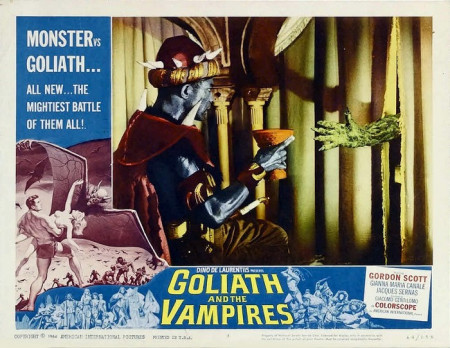
This impurity was perhaps the defining feature of Italian products. It could be glimpsed in the haunting vision of Queen Lydia’s crypt in which former lovers become petrified statues in Hercules Unchained or the gruesome fate of the sacrificial victims to Proteus in Vittorio Cottafavi’s Hercules Conquers Atlantis (Ercole alla conquista di Atlantide, 1961). In Giacomo Gentilomo and Sergio Corbucci’s Goliath and the Vampires (Maciste contra il vampiro, 1961), the Oriental Kingdom of Salmanac is terrorised by a shape-shifting, blood-sucking apparition that materialises in wrathes of red mist, floating in mid air, fangs and talons poised to feast on the blood of virgins. Kobrak (‘the vampire’) is capable of changing his form at will: during the film’s climax he morphs into Goliath himself so that at the final moment, courtesy of some crafty special effects, Goliath appears to grapple with Goliath. The film is suffused with an atmosphere of spooky sadism and exotic sensuality, decorated with a bone-strewn desert, a depraved Oriental court and a frozen underground lair that conceals an army of blue humanoids. Goliath and the Vampires is a period adventure that exceeds every other production of the time by gleefully raiding adjacent genres (horror, science fiction). Corbucci, like Bava, had the talent and temperament as a director to take these things to their logical conclusion: his Roman epic Son of Spartacus (Il figlio di Spartacus, 1962) and Spaghetti Westerns Django and The Great Silence stand out for their handsome scale and pitiless brutality.
This wildness, this lack of decorum and taste, a refusal to acknowledge any aesthetic boundaries and push at both moral and legal limits, became a basic driving force of Italian genre cinema, taken to extreme horizons by directors like Lucio Fulci and Ruggero Deodato. It pushed the peplum cycle through to its farcical end and ushered in the amorality, violence and eroticism of the Spaghetti Westerns, horror movies and gialli of the later 1960s. The brutality of the pepla set a precedent for the aesthetics of Italian film by depicting violence with more felicity and imagination than their American models. Movies like Goliath and the Vampires or Carlo Compagalliano’s ruthless romp Goliath and the Barbarians (Il terrore dei barbari, 1959) and his voluptuous, savage Son of Samson (Maciste nella valle dei re, 1960) opened with whole villages and towns being massacred in surprising, gory detail: the innocent burnt or buried alive, stabbed or impaled, with no mercy for women or children. In later pepla like Son of Spartacus or Ferdinando Baldi’s Son of Cleopatra (Il figlio di Cleopatra, 1964) the brutal, parched landscape, visual motifs and pessimism of the Spaghetti Western had started to be sketched out — pitiless bursts of violence perpetrated by desperate men on horseback in barren desert wastelands.
The violence was balanced by an extravagant sensuality that was deliberately provocative — the basic currency of Italian cinema. There is a retrospective tendency to focus on the homoerotic presentation of the lead actors in the pepla: bodybuilders like Steve Reeves and Reg Parks romping around in skimpy loincloths, flexing oily torsos and wrestling circus lions. But this is misleading, ahistorical and misses a key point: the pepla often revolve around the motivations, machinations and sexual allure of their women. The female characters were not just sex objects in these films: their erotic charisma often suffused the entire narrative and propelled it. If the central protagonist was invariably the muscular and moral hero, a Hercules or a Maciste, then his real nemesis was more often than not a dynamic and seductive queen or courtesan, forerunners of the Gothic femme fatales looming on the horizon. Occasionally controlled by a larger, more malevolent force (Kobrak in Goliath and the Vampires; a race of rock-headed, be-caped aliens in Giacomo Gentilomo’s legitimately camp and demented Hercules Against the Moon Men), they invariably stole the show.
Hercules Unchained, for example, belonged to Sylvia Lopez, the tragic starlet who died of leukemia one year after the film was released. Her Queen Omphale is an outstandingly lurid and febrile creation: decked in gossamer suits and diaphanous gowns with eyes like steel daggers and lips like lava, she is eventually driven mad by desire, immolating herself in her own cave of horrors like a Technicolor Barbara Steele. In Son of Samson and Goliath and the Barbarians, Chelo Alonso (“the Cuban H-Bomb”) provided a lethal sexual charge by deploying seductive dance routines learnt at the Folies Bergere in Paris, vamping and murdering her way through the Mongols of Central Asia and the dangerous schemers of Pharaonic Egypt in luxurious and only vaguely period-appropriate couture mini dresses. As Queen of the Amazons in Hercules, a wily courtesan in Goliath and the Vampires or a corrupt and lusty aristocrat in Son of Spartacus, Gianna Maria Canale exuded a graceful and intelligent menace that finely balanced the outré sexuality of Alonso and Lopez. Lydia Alfonsi excelled at the role of Prophetess often key to the mythological mini-epics, adding mystery and dignity to such roles as the Sybil in Hercules and Cassandra in Giorgio Ferroni’s The Trojan Horse (La guerra di troia, 1961). In their original context these films pushed boundaries to produce some of the most memorable yet forgotten lead performances by any Italian actresses.
The peplum provided a perfect vehicle for the visual sensibility of the Italians, and an important opportunity to develop their talent and expertise in special effects, set and costume design. If there is one thing that distinguished the best Italian productions from their American models, it is their rich visual texture. The Italians presented their stories in dynamic, saturated colour. Caves, grottoes and crypts were drenched in jarring blues and livid reds, piercing golden shafts and aquamarine washes. Pioneered and inspired by Bava, the lighting did a lot of work: cheap tricks devised to conjure vivid and unnatural dream states and hallucinatory nightmares. In fact, the visual signature of Mario Bava is all over the most effective and beautiful-looking pepla, even those without his direct involvement like Hercules Conquers Atlantis (a visual and thematic wonder), or Goliath and the Dragon (Le vendetta di Ercole, 1960) in which Cotaffavi painted a broiling volcanic landscape that was only let down by the ridiculous fire-breathing rubber puppet that Mark Forest wrestled at the climax of the film. Most productions required a dance sequence, both an obligation and a chance to show off: in the hands of Bava these became extreme candy-coloured confections, inserts of exotica that enhanced the dreamy delirium, like budget versions of the Powell and Pressburger ballet extravaganzas in The Red Shoes and Tales of Hoffman.
In the gutter of the Italian film industry — where outrageous talent and motivated hacks combined to create magic in a world that was both mercenary and anarchic — the pepla provided the likes of Bava, Freda, Leone and Corbucci with the opportunity to begin to realise their own style. They were able to curate and train their own audiences here, feeding them lavish fantasy and extravagant spectacle in regional cinema pits. This was the first filone and it set the commercial and stylistic template for the Spaghetti Westerns, spy capers, Gothic horrors, gialli and poliziotteschi to come. The tendency towards extreme mannerism established during the peplum era would be fully developed in everything that followed — the thread that started here can be traced all the way through to the visual assaults of Dario Argento and Lucio Fulci. With their grand themes and frantic approach, these films wore the scars of Italian society in the heat of industrial and cultural revolution, but, like the Gothic horrors and Spaghetti Westerns, they did not try to preach or convert. Like the best Hollywood genre products, the ideas they explored were not delivered as programmes or slogans, but symptoms of fear and desire, aspiration and dislocation (2). Ignored now, they are worth revisiting (and where possible, fully remastering, 3) for their visual and stylistic achievements but also as central and living documents of a country with unmatched cultural resources and abilities being transformed at every level, from every direction. They are waiting, still, to be rescued and rediscovered.
- ‘Centaur’s Food’ in Robert Graves, Food for Centaurs (Doubleday & Co., 1960). William Graves would partly blame use of psychedelics for his father’s late mental decline, see Joshua Hammer, ‘Robert Graves Found ‘Perfect Tranquility’ in Majorca’, New York Times, July 3, 2015
- The best example of this is perhaps Hercules Conquers Atlantis, in some ways the most ridiculous of all the pepla but also the most interesting. In the film, Queen Antinea’s Atlantis is a technocratic tyranny with eugenic ambitions to “change men…create a new race.” The mythological setting tilts into science fiction and even exploitation, with its Futurist cityscapes and charged erotic apparel: the fetishistic black leather uniforms and weapons of Queen Antinea’s guards, as well as her own prowling, vicious performance as a kind of Atlantean dominatrix. The thematic echoes of Mussolini’s own mad dreams of a fully aestheticised and pure totalitarian state are obvious and it is worth remembering that these films were being produced only fifteen years after the final destruction of fascism in Italy.
- The model would be Arrow Films’ exquisite release of Erik the Conqueror: their 2K restoration (with the original Italian vocal track) is a revelation. The reputation of films like Hercules, Hercules Unchained, Hercules in the Haunted World, Hercules Conquers Atlantis and Goliath and the Vampires would be transformed by similar treatment and presentation. Whether this will ever be possible, either technically or commercially, is another matter.
 Oliver Craner